Restless, not frustrated: what AHMTEC told me about AI and access to medicines
Reflections after AHMTEC on will, sovereignty and the chance to leapfrog with AI in African access to medicines.

Sofia Radley-Searle
Co-Founder and COO
5 minute read
In one of my panels at AHMTEC in Addis Ababa, the moderator turned to me and asked: "As a tech innovator working in such an analogue space, do you get frustrated?"
I paused. Frustrated wasn't quite the word. Restless was.
I've been thinking about that answer ever since I got home, and about the bigger question underneath it, which followed me through the whole week: is there a real will to use frontier technology, including AI, to sustainably improve access to medicines in Africa?
Two sides of the same room
The coffee was strong and the energy was electric. Between three panels (on pooled procurement, women's healthcare and sustainable pharmaceutical markets) and more than twenty meetings, plenty of "just five minutes" conversations turned into long insightful chats. And in those conversations I kept hearing very similar stories, two sides of the same coin.
Manufacturers told me: “we can produce, we have the quality, but we can't plan around demand we can't see. We're asked to register products in each market with no efficiencies and repetitive fees. We're asked to do business with no certainty on when we'll be paid.”
An hour later, a procurer would tell me: “we need quality, speed and more cost-effective options, but our budgets are tight, and we have tons of regulations to operate within”.
They were describing the same market from opposite ends, each needing exactly what the other could offer. This year's theme was "Industrialise to Commercialise", and commercialising is exactly where those two ends have to meet. For three days we talked about capacity, financing, regulation and markets. The technology that could connect them barely came up. At times, it felt like I was the only person in the building talking about how AI applies to this space.
Restless, not frustrated
So why restless? Because I see what other industries are building on top of AI. I know what we've built at Axmed, and how much faster we make procurement and how much we already strengthen African competitiveness and purchasing power. And yet I see global health stakeholders hesitating to leapfrog, to partner in new ways, and to seize this moment with real determination.
Axmed is transforming how medicines are bought, verified and delivered. We’ve all seen enough pilots that never scale, enough commitments and memoranda of understanding, enough dashboards. Many of us want to see the system actually work differently, and with willing partners and Axmed’s technology, we can.
I trained as a pharmacist, and what strikes me most is how unscientific the biggest barriers are. Improving access to medicines doesn't require discovering the next therapeutic target, inventing the next battery or putting a man on the moon. The barriers are structural inefficiencies, market failures, sustained by lack of data, transparency and digitization. Those are exactly the problems where technology can do the heavy lifting: reading thousands of documents, matching supply to demand, spotting risk in patterns no team could track by hand, forecasting more accurately, mapping what procurers have in common, and giving manufacturers lower-risk, stronger plans to enter new markets.
The hard part is not the technology, maybe it never was. It's deciding to use it, and then executing. Where there's a will, there's a way. So, is there a will?
Why the answer matters now
Despite the restlessness, I left Addis optimistic. A year after the Accra Reset was launched at the UN General Assembly, leaders across the Global South are moving from declarations to delivery on health sovereignty. Regulators are getting stronger through WHO's benchmarking and maturity-level process. Manufacturing is scaling on the back of the right quality investments. For the first time in history, Africa has a real shot at going from importing most of its medicines to competing globally as an exporter. I believe that's something we can see happen in our lifetime.
But I also heard, more than once, the familiar reasons why not. The rules don't allow it. The process takes time. We've always done it this way. Follow these steps and we can talk again in six months.
I'm yearning to see that flipped. Regulation and procurement rules should be frameworks that evolve, not reasons to stand still. Used well, they can give sovereign nations a real competitive edge: faster, more transparent and more trusted than the systems they were modelled on. Regulatory sandboxes, where a new technology or platform can be pressure-tested in a controlled, de-risked way, with regulators and national procurement agencies in the lead, would be a good start.
Africa has leapfrogged before. The continent skipped landlines, went straight to mobile, and then built mobile money that the rest of the world now studies. Medicines procurement can do the same. There's no need to replay policies designed for another era. Nations can go straight to AI-enabled procurement, and the payoff goes well beyond health: stronger local manufacturing, more exports, more industrial growth and more GDP.
Global health has too often been the last to adopt each new technology. That was never neutral. Not building on the best tools available is a quiet decision to keep the system inefficient, and an inefficient system fails patients.
What leapfrogging looks like in practice
When I say leapfrog, I mean something concrete. At Axmed, AI turns a buyer's scattered requests into a structured tender in a fraction of the time it used to take, and lets us pool demand across buyers without forcing them all to agree on the same SKUs or how to split quantities. It finds and qualifies more suppliers, including African manufacturers that international tenders often overlook. In 2025, 78% of winning bids on our platform came from African suppliers. Agents trained on GMP and GDP make audits faster and help manufacturers improve rather than simply pass or fail, because the aim is a stronger quality culture across African manufacturing, not a stricter gate. And digital feedback all the way to the point of delivery holds every supplier to honest, real-time standards. In 2025, buyers saved 35% on average, and every product was quality-checked before it shipped.
Back to that panel
If someone asks me next year whether I'm frustrated, I hope my answer is different. I hope I'm not the only one talking about AI. I hope the regional pooled procurement mechanisms being set up right now become pioneers, and that we all arrive asking not whether to adopt frontier technology, but how fast, and how far it can take African manufacturers as exporters and African procurers as savvy buyers.
Africa is taking back the right to decide. As innovators, are we making sure African procurers and manufacturers have the best technology infrastructure to leapfrog?
This time, global health can't be left behind.
Insights
Keep reading
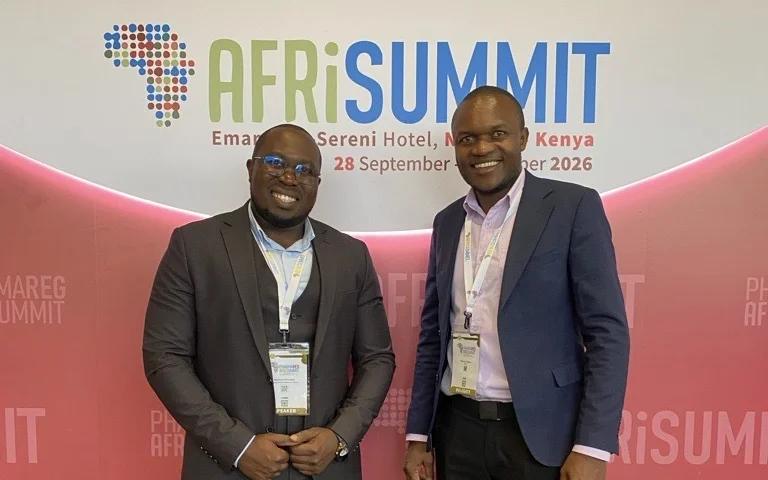
Is Regulatory Approval The Happy Ever After? What Comes After the 'Regulatory Finish Line'
Reflections from PharmaReg AfriSummit 2026 on connecting regulatory approval, procurement, financing and logistics to real patient access.
- PDF
Why the new normal in global health requires a new access model
Development financing has changed permanently. Axmed Global Health Advisory's Access360 framework builds access strategy into product development.
Axmed Global Health Advisory

How we are making pharmaceutical quality scalable and accessible with AI
How Axmed turns day-long manual prequalification and GMP and GDP audit work into real-time quality intelligence with AI. By Sofia Radley-Searle, COO.
Sofia Radley-Searle